








A variety of joint disorders are caused by overexertion, trauma, other diseases, overweight and age.
Joint replacement and rehabilitation
In a joint replacement, the worn-out articular surface is replaced with an artificial one. The procedure is prescribed if the patient suffers from joint pain and impaired joint function, and if conservative treatment methods (medication, physiotherapy, massage, etc.) do not work. After the replacement, the patient spends some time in hospital - how long is determined by the doctor after assessing the patient's condition and the complexity of the operation. Once the pain killers have worn off and the patient can feel his/her feet, it is a good idea to exercise them immediately and try to stand up (ideally with a doctor nearby).
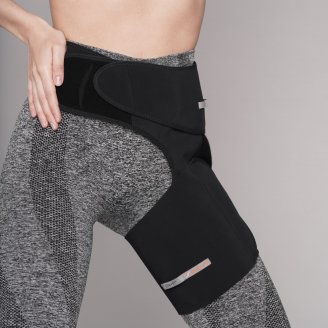
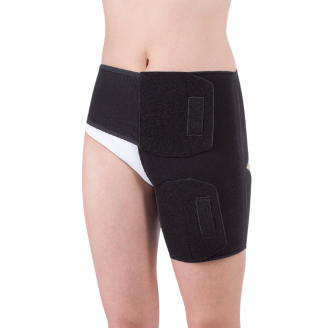
After discharge from hospital, rehabilitation treatment is recommended, during which an individual rehabilitation plan is drawn up for each patient. Usually, after an arthroplasty, the patient receives medication to reduce pain and prevent complications, as well as compression therapy, physiotherapy, occupational therapy, massage, and orthopaedic devices to ensure joint stability. After arthroplasty (including arthroscopy), a hip splint is recommended to reliably stabilise the hip joint, improve muscular coordination, and create a slight distraction effect, which is particularly important after hip replacement when cross-leggedness is not allowed to prevent dislocation of the joint.
The post-operative period and healing are usually short, often lasting up to a year. Adequate physical activity, exercise and specific exercises are essential in the post-operative period. It is also important to remember that although the implant allows you to restore the joint's function, you will still need to follow certain guidelines, such as:
- not lifting objects off the ground with your legs extended;
- do not raise the knee above the hip;
- do not cross your legs;
- no inward rotation of the operated foot;
- no bending of the leg more than 90 degrees through the hip joint;
- avoid heavy loads on the hip joint, such as jumping, running, lifting heavy objects, etc;
- not taking a bath (not a shower) until four months after surgery;
- walk regularly;
- use a pillow between your legs when sleeping;
- choose comfortable footwear, etc.
Joint arthroscopy and rehabilitation
Joint arthroscopy, which is rapidly gaining in popularity, allows for quick and effective joint surgery. The hip joint is operated on arthroscopically if the damage is quite extensive but the joint is not broken and no prosthesis is needed. This procedure involves making several small incisions through which optical devices are inserted into the joint, allowing the joint to be viewed from the inside and operated on.
Hip arthroscopy is still poorly performed in this country compared to knee arthroscopy, which is one of the most advanced and fastest interventions for treating knee disorders.
The rehabilitation time after hip arthroscopy depends on the level of the lesion and the complexity of the operation, but is usually outpatient and much shorter than after joint replacement surgery.